
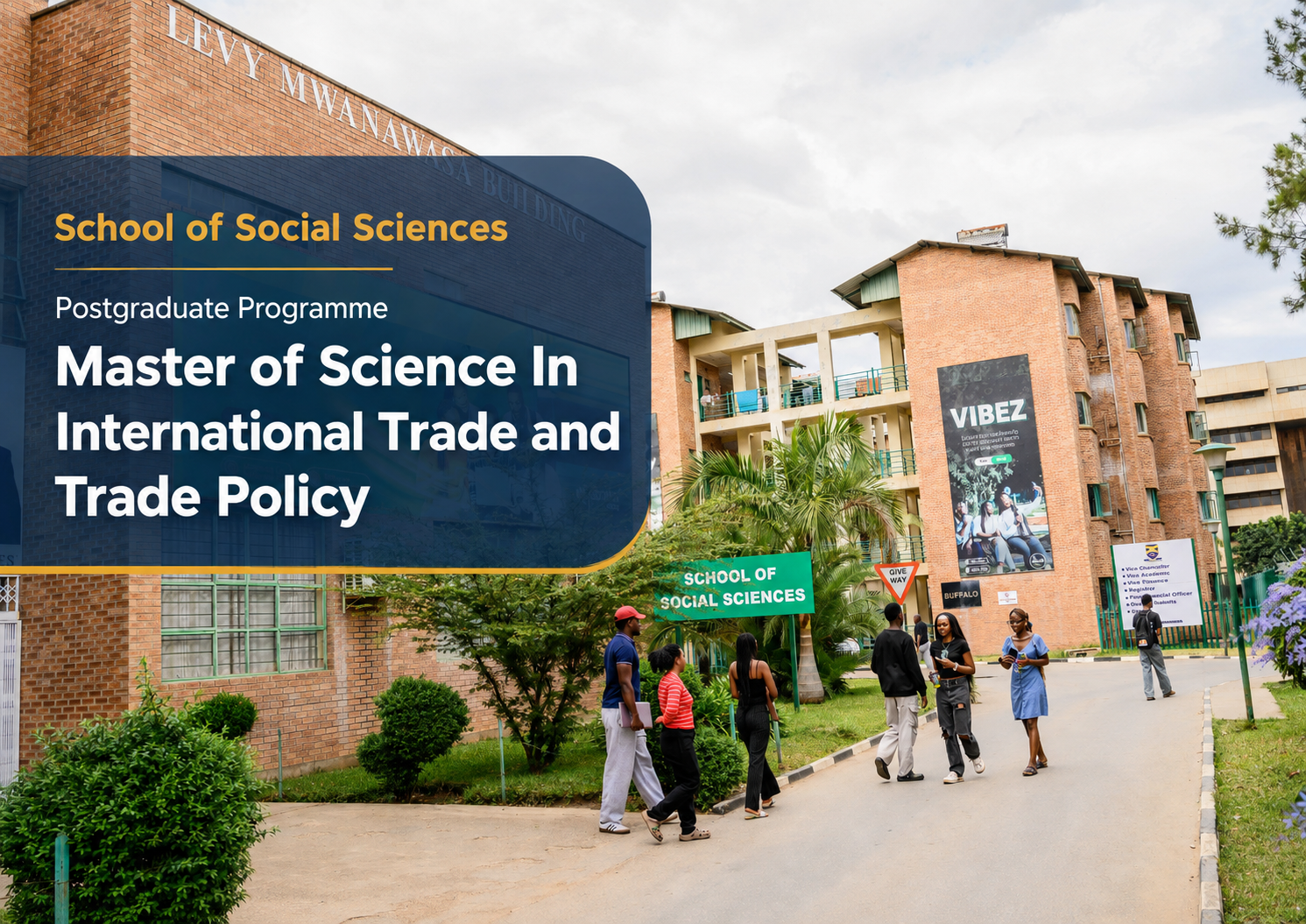
School
School of Social Sciences
Duration
18 months to 2 years
Intake
January and July intake cycles
1.0 INTRODUCTION
This Programme Guide details the contents of the Master of Science International Trade and Trade Policy (MITP) degree programme and is accordingly structured as follows. The programme rationale, aim, objectives and target group are outlined in Sub-sections 1.1 to 1.4 respectively, while the admission criteria and programme regulations are given in Section 2.0. Section 3.0 and 4.0 outline the assessment criteria and exemptions, while course codes and the programme structure are outlined in Sections 5.0 and 6.0 respectively.
1.1 RATIONALE
In a climate of enhanced global competition, attention for economic diplomacy has substantially grown, for example, the Government of the Republic of Zambia has decided to prioritise economic diplomacy in the practice of international relations. Secondly, the Ministry of Commerce, Trade and Industry recently expressed interest in International Trade and Trade Policy course.
This programme conceptualizes economic diplomacy and adds to a better understanding of its central place in the theory and practice of international trade. This programme will successfully prepare students for a wide range of high-level and global careers to suite and meet the current and future market demand from potential employers such as government, consulting firms, and policy-oriented organizations. Perhaps more importantly, this programme will contribute to the attainment of Zambia’s 2030 Vision.
1.2 AIM
The aim of the programme is to prepare students for a challenging career in international trade and commercial diplomacy assignments. The programme will provide to the students the opportunity to develop their understanding of international trade and commercial diplomacy. It will further use the principle of evidence based learning to expose students to current themes in international trade theories and policy.
1.3 OBJECTIVES
By the end of the programme, students should be able to:
Collect and analyse economic data to help in solving challenges related to international trade and commercial diplomacy
Practice drafting of key provisions of treaties and related instruments
Discuss and apply the principles of treaty interpretation in international law
Model and analyse economic implications of trade agreements
Analyse RTAs agreements
Examine trade facilitation approaches and implementation outcomes that support integration efforts
1.4 TARGET GROUP
The MSc International Trade and Trade Policy degree programme is designed to meet the growing demand for practitioners and researchers in international trade and trade policy. It is intended for university graduates with qualifications in economics, public administration and /or business administration related fields who have studied macroeconomics, microeconomics, public administration and international trade at intermediate level.
2.0 ADMISSION, GRADING AND AWARD CRITERIA
2.1 ADMISSION CRITERIA
To qualify for admission to the MSc International Trade and Trade Policy degree programme an applicant must have any of the following qualifications:
a degree in economics, public administration, and business administration from a recognised institution, provided that the candidate has studied macroeconomics, microeconomics, public administration and business administration at intermediate level as part of the degree or any other recognised qualification; or
any relevant degree from a recognised institution, provided that the candidate has studied macroeconomics, microeconomics, public administration, and business administration at intermediate level as part of the degree or any other recognised qualification.
2.2 REGULATIONS GOVERNING THE AWARD OF MSc DEGREE
2.2.1 Duration of study
The programme of study for the award of the MSc International Trade and Trade Policy qualification shall be completed in a period of not less than 18 months and not more than three academic years.
For the purpose of computing the maximum period of study where a person undertakes the study for the MSc International Trade and Trade Policy qualification, partly as a part-time/evening/distance education and partly as a full-time student, three (3) courses successfully completed by the student shall count as one academic semester (one half year).
2.2.2 Student progression
The Programme of study shall be taken in the sequence approved by the ZCAS-U Senate.